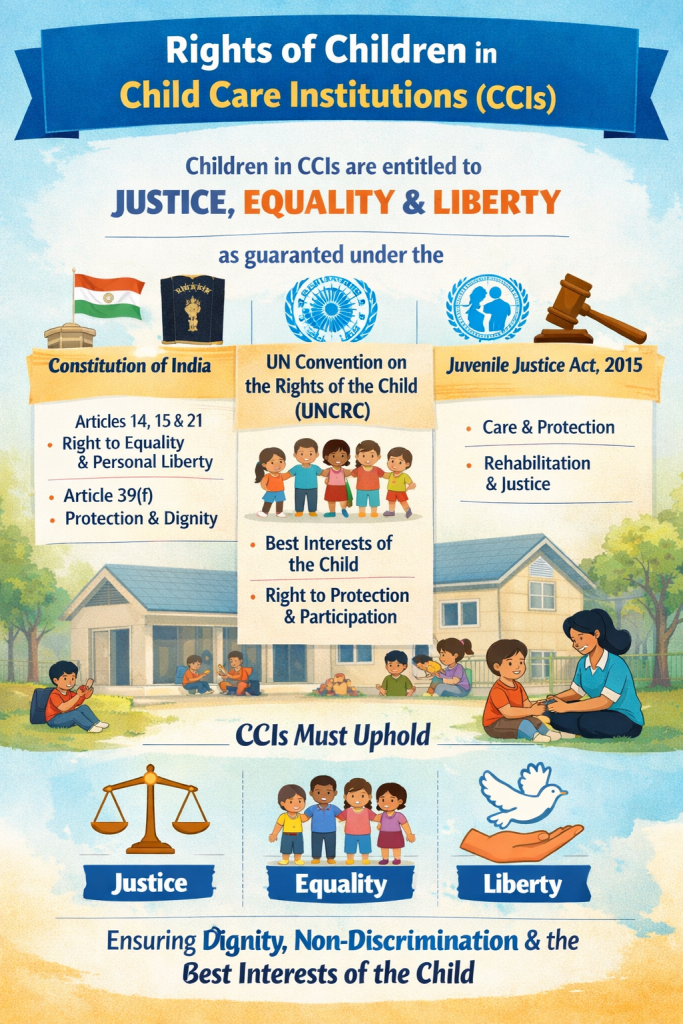
Children residing in Child Care Institutions (CCIs) are entitled to justice, equality, and liberty as fundamental and non-negotiable rights, firmly grounded in the Constitution of India, the United Nations Convention on the Rights of the Child (UNCRC), and the Juvenile Justice (Care and Protection of Children) Act, 2015. Articles 14 and 15 of the Constitution guarantee equality before law and non-discrimination, while Article 21 ensures the right to life and personal liberty with dignity. Article 39(f) further mandates that children be protected against exploitation and provided opportunities for healthy development in conditions of freedom and dignity.
The UNCRC reinforces these constitutional guarantees by affirming the child’s right to survival, development, protection, and participation, and by requiring that the best interests of the child be a primary consideration in all actions concerning children. It emphasizes the child’s right to be heard, protected from abuse and neglect, and supported in achieving their full potential.
The Juvenile Justice Act, 2015 operationalizes these principles within India’s child protection framework by providing a rights-based, child-centric approach to care, protection, rehabilitation, and social reintegration. It mandates that children in CCIs receive humane care, due process, access to justice, and opportunities for family-based or community-based care. Together, these frameworks require CCIs to function not merely as custodial spaces, but as rights-affirming environments that uphold justice, equality, and liberty for every child.

 Safe Childhood India
Leave a comment